Skip to Content

Gear : Essential Equipment : Protection : Active : Ultralight TCU

< Previous | Next >

Ultralight TCU

Average Rating = 4.27/5 Average Rating : 4.27 out of 5
Item Details | Reviews (27)
Ultralight TCU
Manufacturer: Metolius

Available now at:

Go Moosejaw Use coupon code "AVANT10" to get the price displayed on this page. $54.95 $42.04 Buy NowUse coupon code "AVANT10" to get the price displayed on this page. Gear CouponUse coupon code "AVANT10" to get the price displayed on this page.
Go e-OMC $49.50 $42.95 Buy Now
Go Altrec $49.50 $44.79 Buy Now
Go Campsaver $49.50 Buy Now
Go AppOutdoors $49.50 Buy Now
Go BackCountry $54.95 Buy Now
Go REI $54.95 Buy Now
Go SummitHut $54.95 Buy Now

Description

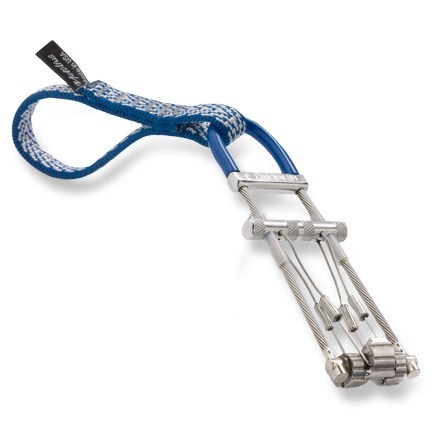
On free, alpine or aid routes, these ultralight TCU cams feature Direct Axle Technology for awesome performance and weight savings. Direct Axle Technology allows greater placement options in shallow, narrow or bottoming rock features. Also makes tricky placements easier due to better cam lobe visibility, especially in the smaller sizes. New Range Finder markings eliminate guess work: Green Zone for go, Yellow Zone for caution or trade up sizes and Red Zone for stop U-shaped body provides greater durability and better control during placement and retraction. Durable, flexible, stainless-steel cable body with long-wearing trigger slides are lightweight, strong and allow easy placement. Split-wire triggers with knurled trigger bars allow you to use one, two or three fingers--or even gloved hands. Features three, wide CNC machined 0.25 in. cams of super-durable 7075-T6 aluminum. Machined cam stops and radiused teeth increase cam durability and holding power optimized cam angle applies more outward force. Lightweight Dyneema nylon slings are color-coded for quick, easy identification and less bulky than standard nylon slings.

Submitted by: j_ung on 2006-01-06 | Views: 2640


27 Reviews

GoWrite your own Review
GoRead all 27 reviews


Review 4 out of 5 stars

Review by: z_rock90, 2006-09-13


I give the TCU a 4 because they walk alittle and I wish they had extendable cam slings. But I have used the older ones Pre-DAT system and have had the end caps mess up the placement.

Review 4 out of 5 stars

Review by: p0bray01, 2006-08-17


No text provided

Review 4 out of 5 stars

Review by: ctardi, 2006-07-31


I learnt on TCU's and Technical Friends, so I am biased towards both of them. The TCU is wonderful. Range finder, not so much.

It can get into some fairly tight places that no four camed unit could. I'm a bit sketchey towards aliens, and C4's are a bit rich for my blood, so I just got me a shiney new set of these!

I gave these a four instead of a five because I do not like the range finder. It is a good concept, but it both promotes overcaming, and I find it is usually hard to see the range finding dots. Perhaps it could be fixed by annodizing just the undercammed notification area, leaving the rest silver?

Highly reccomended! I think in the set mine ended up being $42CAD each, and I got 6 of them, and a thing of cam lube.

Review 5 out of 5 stars

Review by: freeledgeledgy, 2006-04-04


No text provided

Review 5 out of 5 stars

Review by: dingus, 2006-01-08


[size=12][b]Full Disclosure: The company that manufactured this equipment provided it free of charge to RC.com and RC.com then provided it as compensation to the reviewer for his or her review. This company does not currently advertise on RC.com.[/b]

Did you ever have a love affair with a piece of hardware? Wait a minute, you’re reading a gear review. Of COURSE you’ve had a love affair with a piece of hardware! What was I thinking? We always remember that first affair too, don’t we?

I acquired my first Metolius TCUs almost 20 years ago. Up to that time rigid stem Friends were pretty much the only game in town. The TCU was aimed squarely at the niche where Friends fared poorly, small cracks and horizontals. As soon as I saw them, I had to have them.

OMG, what a huge difference they made! Strong, compact, versatile, the 4 smallest units found a home on my rack immediately. And they stayed there. Other small pro came and went, but when headed up thin cracks I wanted those Metolius TCUs. I’d sneak em onto my bud’s rack when he wasn’t looking. He was a Wired Bliss man and sorta fickle about it, so I had to be sneaky.

You have to go back to the early 80’s; Smith Rock, Oregon country, prior to the sport climbing revolution, which was just getting started. Coursing full grown from an artesian spring, the Metolius River taps the deep aquifers of the Cascade Range and flows past the tiny village of Camp Sherman. That’s where Doug Phillips lived.

Doug invented Sliders and started Metolius working out of his two-bay garage. He hired and taught Steve Byrne to work with silver soldering. Friends hit the market big time right about then and everyone was looking for cams that would fill the gap below the #1 Friend.

From their collaboration the TCU was born, a stable 3-cam, U-shaped cable stem unit that would revolutionize small crack climbing protection in the same way the Friend did for larger cracks. I bought my first orange TCU in 85 or 86. That very same orange TCU is still on my back up rack as I type these words.

This year Metolius introduces their new Ultralight series; TCUs, Power and Fat Ultralights. I have been actively field testing them for the past couple of months. If I could summarize my findings with one work, it would have to be SWEET.[/size]

[img]http://photos.rockclimbing.com/photos//673/67388.jpg[/img]

[size=12]Let’s establish this: I’m no engineer, nor do I evaluate climbing gear for a living. See the professionals for such tech data. Me? I’m a climber and a writer, and this review is written with inherent bias. I like these cams a lot, no, I love them and I would like to tell you why.

Feel - when you pick up and hold a TCU or Power Cam, it just seems to fall right into your hand. It is solidly built, with no slop in the design or the manufacture. Pull the trigger; its buttery smooth and offers very tight control over the individual cams. The cam lobes rotate as if they sported di-lithium crystals in the bearings.

Durability – might as well be a trademark of Metolius hardware in general! Face it, their stuff is built to last. Their cams have proven themselves time and again in the field, on the racks, over the years, over and over. The design works, the materials hold up. Trigger wires, the bane of many a contender, just seem to hold up with minimal or no maintenance at all. Aid, free, bounce testing, aggressive cleaning, stuffed into the bottom of a pack; they hold up to the abuse.

Utility – work horse pieces. Many a trad rack is formed on a backbone of TCUs and Power or Fat Cams. They offer superior holding power and excellent expansion ranges. They’re not so long as to dangle at your knees and not so short they are overly difficult to clean. Across the models they work in most kinds of rock.

I love TCUs for pin scars for example, the way the center cam is free to rotate. I can remember individual cam placements where a Metolius is the only piece that will work. They’re like old buddies, when they meet up, placement and cam!

So the Ultralights? All that, and less. They should consider a tag line for the upcoming Metolius Superbowl commercials:

The Ultralights are ultra light. They may be the lightest FULL RACK of cams on the market. Piece for piece, they are as strong as any competitor and as light, or lighter. When you pick one up, it feels like your hand actually gets LIGHTER. I know, I’m getting carried away, but go pick one up, you’ll see.

Some modern cams surrender weight by shortening the length of the cam. Metolius tried this in some prototypes, but field tests confirmed suspicions. Really short cams are hard to place and even harder to clean, especially in the small sizes. The Ultralights are the same length as their predecessors.

Metolius reengineered the axle design, incorporating what they call DAT, Direct Axle Technology. Gone are the heavier (and wider) axle end-caps of the older design. Instead, the cable stem is attached directly through holes in the axle. Especially in the small sizes, the end caps of the old design could get in the way, cause the piece to bottom out in shallow placements, inhibit rotation or even help the cams to walk, or not engage at all.[/size]

[img]http://photos.rockclimbing.com/photos//673/67389.jpg[/img]

[i]DAT in all its glorious, vivid detail. [/i]

[size=12]DAT eliminates that bulk. You can see the cams better, and there is less restriction in tight placements. Other features include the Range Finder color-coded dots. At first annoying to this old schooler as a marketing ploy, I think they’re a really cool reminder of the optimal placement range. I can use all the reminders I can lay my mind on these days.

So how does all this translate to the rock? Well, I have the lightest full-service rack I have ever carried in my career. I can deploy about 12 cams, with individual biners, for about the same weight as 8 in the past, or even 8 of some current competitors. With 200’ foot ropes and pitches increasingly the norm, larger racks are often a modern requirement. It’s something we used to dream about 10 years ago – wouldn’t it be great if… well, it is great.

Angus and I climbed quite a bit with them during our dry late fall; Yosemite, some first ascents up Sonora Pass way, volcanic column cracks, etc. Ultralights place with the same solid feel as their predecessors. They give you the confidence to swim for the next placement. Angus summed it up as we compared notes for that weekend’s trip up Arrowhead Arête:

“Dingus? I got the rope and the rack. You bring those Ultralights Bro!”

My love affair is still going strong after 20 years, for my partner, and for my pro. Metolius Ultralights are SWEET. [/size]

GoRead all 27 reviews


Write a Review